 |
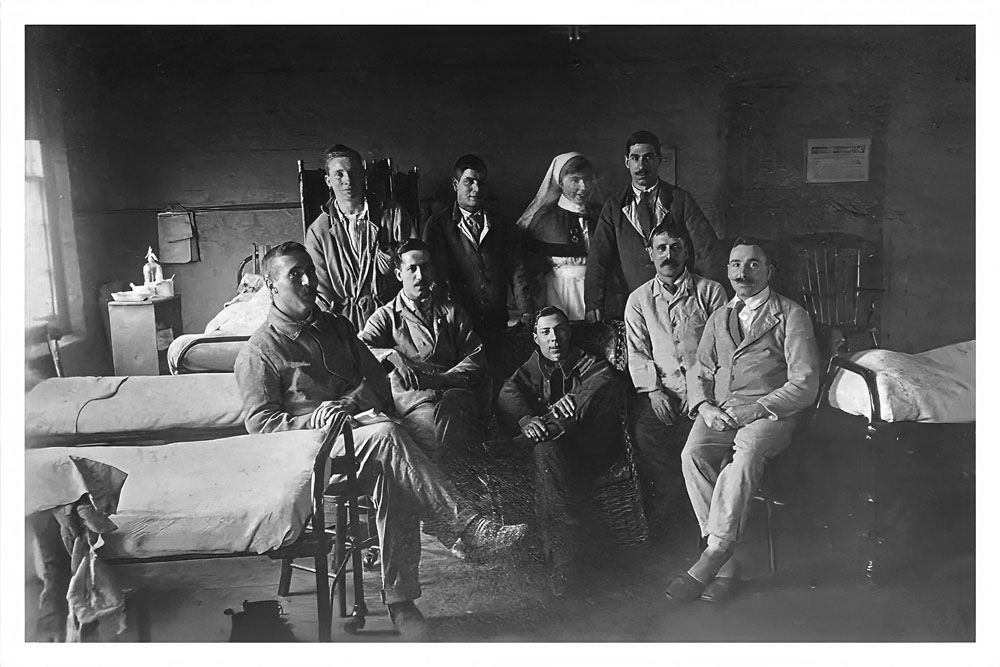
Photograph/postcard (Many thanks to Major [Retd] Janet Brodie-Murphy) showing one of the nurses at the Sanatorium, and recovering WW1 Soldiers.
Soldiers, particularly those suffering from tuberculosis (TB) contracted during service, used the King Edward VII Sanatorium at Knightwick for recovery primarily around and after the First World War, with the facility expanding to meet such needs by July 1915. While it served as a TB sanatorium from 1902 to 1960, it was part of a network supporting wounded soldiers.
The facility opened in November 1902 for tuberculosis treatment, but expanded its capacity during the First World War (1914–1918) to treat returning soldiers.While the primary role of the King Edward VII Sanatorium at Knightwick was treating tuberculosis (TB), there is evidence of its specific involvement in supporting First World War service members through expansion and specialized care.
1915 Expansion for Soldiers: The facility was significantly enlarged and reopened as a "King Edward Memorial" on 24 July 1915. This expansion was directly linked to the increased need for TB treatment among soldiers returning from the front.
Mental Trauma Care: While many soldiers were treated for physical ailments and TB, records from the final months of 1918 show the hospital also admitted cases of shell-shock and neurasthenia (mental trauma linked to war stress).The Standard Sanatorium Regimen, the core philosophy for treating soldiers and other patients involved four main pillars; 1) Fresh Air & Sunlight; Knightwick's location on Ankerdine Hill was chosen specifically for its "purity of air". Patients were often kept in "shelters" or rooms with doors and shutters left open overnight to ensure constant fresh air circulation. 2) Strict Bed Rest; Resting the body was considered essential for healing. In later years, specific "surgical rest" was achieved through an artificial pneumothorax, a procedure where a lung was partially collapsed to allow it to "rest" and heal. 3) High-Calorie Diet; Patients were provided with substantial, high-quality food to combat the weight loss ("consumption") associated with TB. 4) Graduated Exercise: As patients improved, they were prescribed specific amounts of walking or light activity under strict medical supervision.
©peh